
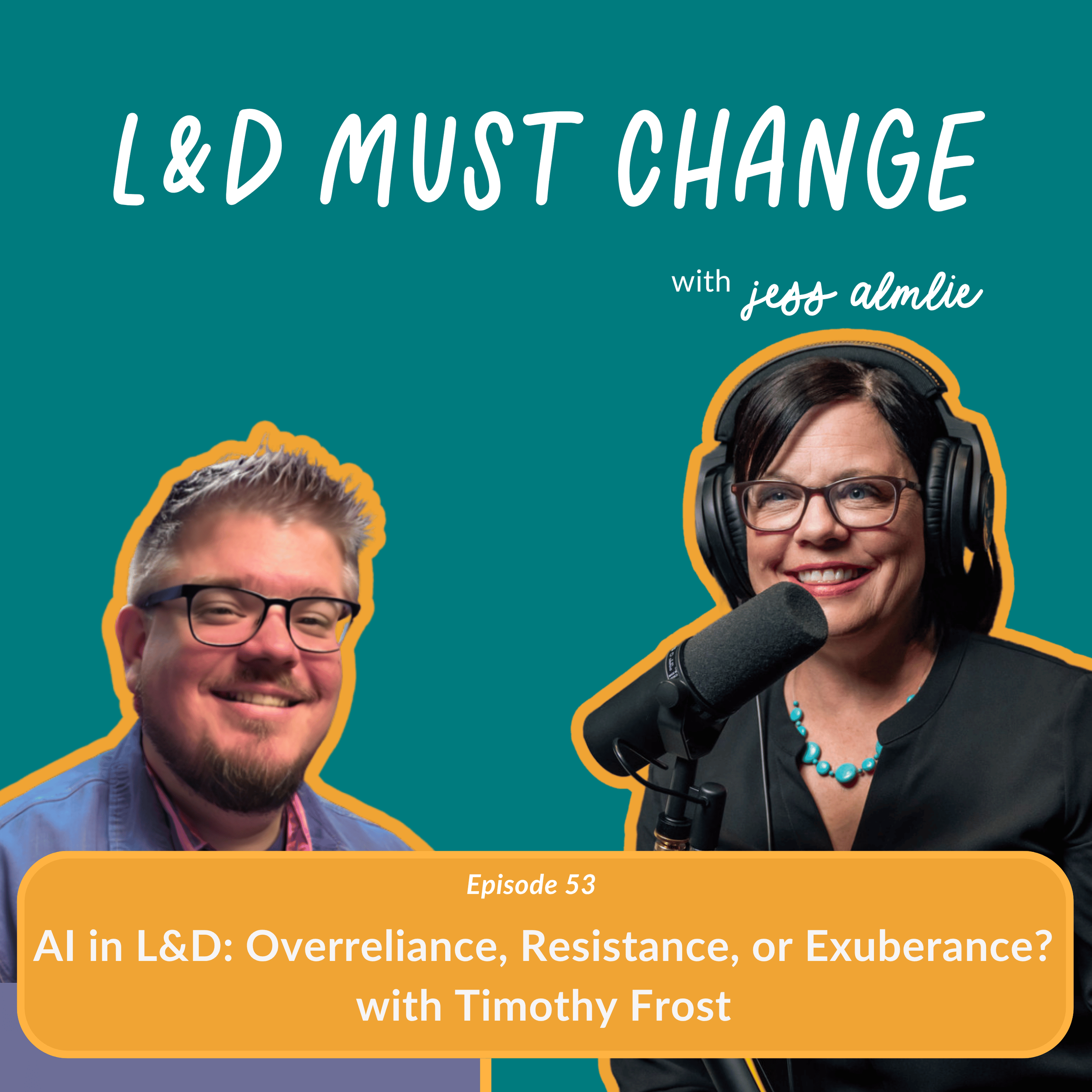
Episode 53: AI in L&D: Overreliance, Resistance, or Exuberance?
Subscribe Apple Podcasts | Spotify
What does it mean when we are asked to “train the business on AI” or even use AI ourselves?
Many L&D teams are being asked to “train the business on AI”… but what does that really mean? In this episode, Jess and Timothy Frost unpack the tension shaping AI in Learning and Talent Development: overreliance, resistance, and exuberance. They explore how these mindsets show up in your daily work, impact learning quality, and influence how you use AI. They also tackle the growing pressure on L&D teams to lead company-wide AI training and share a more strategic approach grounded in clear goals, data, and real use cases. If you are trying to figure out how to use AI without overdoing it or falling behind, this conversation will help you find your footing.
Jess and Timothy Discuss
The “tri-linked crossroads” of AI in L&D: exuberance, resistance, and overreliance
Why AI should be treated as a tool that enhances work, not replaces people
The real reason behind resistance: fear, overwhelm, and reluctance to learn new tech
How overreliance on AI can reduce learning quality and critical thinking
The risk of turning L&D into a “churn and burn” content factory with AI
Practical ways AI improves efficiency like brainstorming, email triage, and idea generation
Why not all AI tools are equal and how to choose the right one for the job
How to push back on executive pressure for cost savings without rejecting AI
A simple framework for leading AI adoption: define the why, analyze data, design learning
How to get started with AI through small, practical experiments
The shift toward in-the-moment, personalized learning powered by AI
Why L&D must focus on working with AI, not just using it
About Timothy Frost
Tim Frost is a digital learning and performance consultant who partners with organizations to solve real business problems, not just build training. With a background in education and enterprise healthcare, he specializes in transforming complex systems into intuitive, high-impact learning experiences. His work sits at the intersection of strategy, technology, and design, helping organizations modernize their learning ecosystems, improve adoption, and create experiences people actually want to engage with.
